And I thought The Souls of Lost Lake was good. Jaime Jo Wright’s The House on Foster Hill—her debut novel, actually—was just as good, if not a little better. I loved it for some of the same reasons, and for some reasons unique to this story.
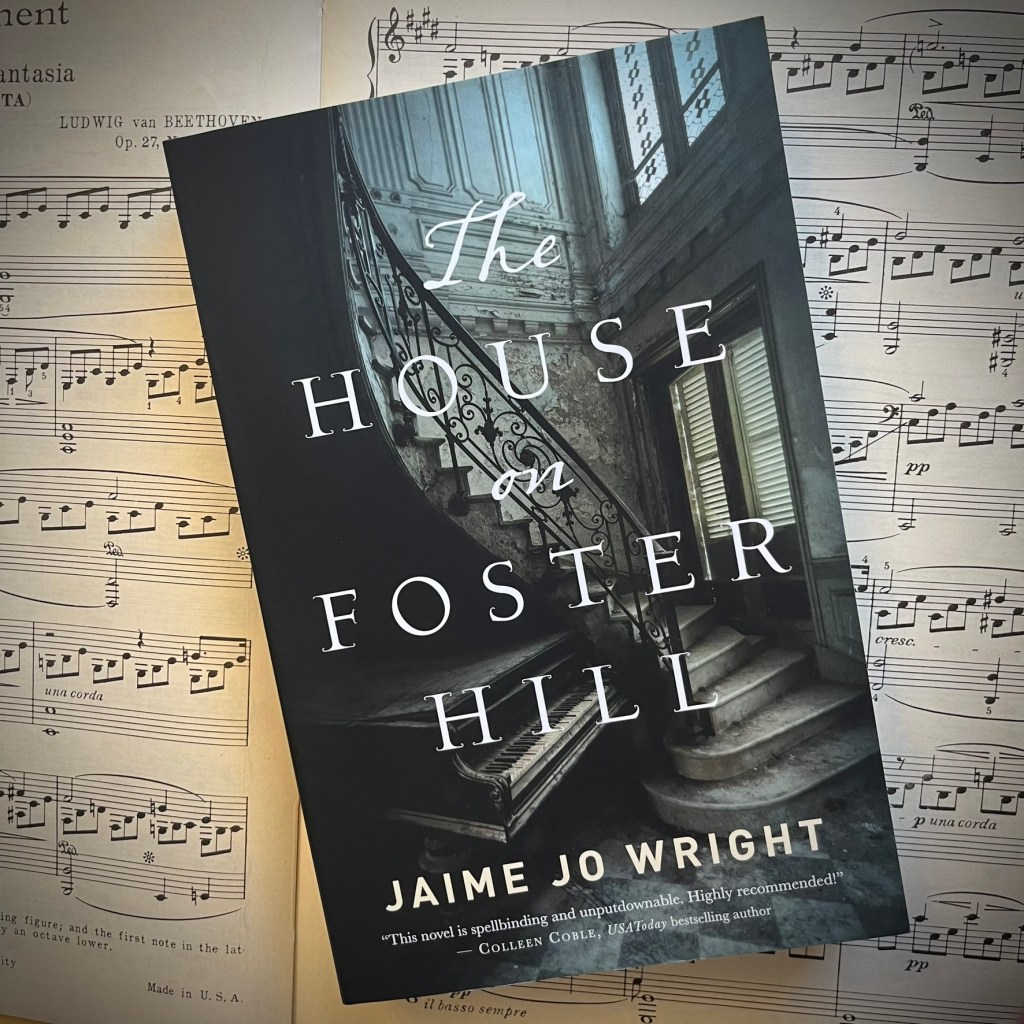
Beethoven piano music in the middle of the night. An abandoned house outside town. A stalker in one world and a kidnapper in the other. Torn, marked pages of a classic novel left as a diary hinting at secrets too deep and too dark for one woman to uncover alone—if she should even try.
I don’t know where to start.
The emotional interest from page one—x5. Both Kaine’s and Ivy’s stories hooked me right away: their backgrounds, their personalities, and their struggles, all evident from the first page, along with their respective settings and circumstances. I was yanked in right away and held tight for the rest of the ride. Kudos to an author like Wright who knows how to grab a reader right out of the gate.
The writing stood out to me much more in this book, whether in descriptions of people or places or in creative portrayals of ideas. (Maybe because I read it rather than listened to it.) I delighted in sentences like, “Grief was a high currency to pay for loving someone, and she paid her dues on a moment-by-moment basis” (10), “Cavernous windows opened in a silent scream on the face of the Gothic house that tilted on the crest of Foster Hill” (22), “The cold air that hit her face . . . was the exclamation mark on the reality that a baby left abandoned could not survive another night” (38), and “His six-foot-one frame wasn’t going to be friends with the low ceiling” (132).
The strong female leads. This element is a trademark of Wright’s stories. And by strong female lead, I don’t mean the woman superhero in long hair and tight leather who kicks butt and saves the world. I mean a strong woman who makes decisions, stands up to her culture, faces challenges, and does hard things, while maintaining 100% femininity such as getting frightened, needing a good cry, and wanting to be cherished. (As an aside, I loved Ivy’s blunt and caustic voice, both in her dialogue and in her narrative.)
The real-life elements couched this story in the world that I know and made the characters and events feel so comfortably, accessibly real. Yoga pants and Navy T-shirts. Downs syndrome. Bad coffee. The shaking legs and gray muzzle hairs of an old dog. Wright captures reality perfectly and uses it as an effective vehicle to deliver her story.
The Wisconsin culture. Having lived in Wisconsin for a few years, I got such a kick out of all the little Wisconsin culture details that give Kaine from California genuine culture shock: cheeseheads, fire numbers, friendly strangers, rural small-town life. The only thing missing was the “ope.” 🙂
The dual story. It blew my mind the way both stories progressed parallel in their respective mysteries without one giving away the other. Wright has proven herself a mastermind in writing dual-timeline mysteries that work together toward a common climax. (And what a climax!)
The Gothic (and real) suspense. What I appreciate about Wright’s stories is that they include some creepiness (and crime) but never too much. An abandoned house, old pictures of old women, strange music at midnight—these are the elements of Gothic suspense that I’m actually coming to enjoy. Even with the real suspense—people disappearing, a stalker with a calling card, what went on in Foster Hill House—Wright keeps the balance between acknowledging the dark sides of reality and telling a safe story. My BP went up a bit (and my emotions got involved), but I didn’t have nightmares.
The historical romance. I found the Ivy/Joel romance much stronger and more intriguing than the contemporary romance. They have so much history and conflict, so many emotional waters to navigate, with questions to answer and angles of their relationship to work through. I could hope where they would end up, but I wasn’t sure and couldn’t predict how. Well done.
The theme. The House on Foster Hill offers one of the most profound themes I’ve read in Christian fiction. As both Ivy and Kaine struggle through the deepening darkness of the mystery and their own circumstances, they also come across Scripture and other Christians who reel them back to the light. The Scripture truths presented, however, aren’t just the generic “God is good” or “God works all things for good”; rather, they dig into a specific way we work out that truth: living today with hope for eternity. There was nothing trite or shallow about the theme in this book, and it impacted me profoundly.
As with The Souls of Lost Lake, there were only (the same) two elements I didn’t enjoy as much:
The contemporary romance. While I couldn’t get enough of Ivy and Joel’s multi-faceted and complex relationship, my eyes rolled a few times at the Kaine/Grant romance. Of course the man still-grieving widow Kaine bumps into (literally) happens to work as a grief counselor—and he volunteers at the dog shelter so he can help her pick out a dog. Oh, and he and his dad had an obsession for local history growing up, so of course he can help her learn more about the Foster Hill mystery. I don’t always read romance, but when I do, I like more layers and obstacles.
Repetition. I thought the characters did a lot of fiddling with sleeves, looking out windows, and hugging self throughout their conversations and actions. While I get the parallel between the historical and the contemporary stories, a few different gestures would have freshened up the writing just a bit. But that’s a small nitpick.
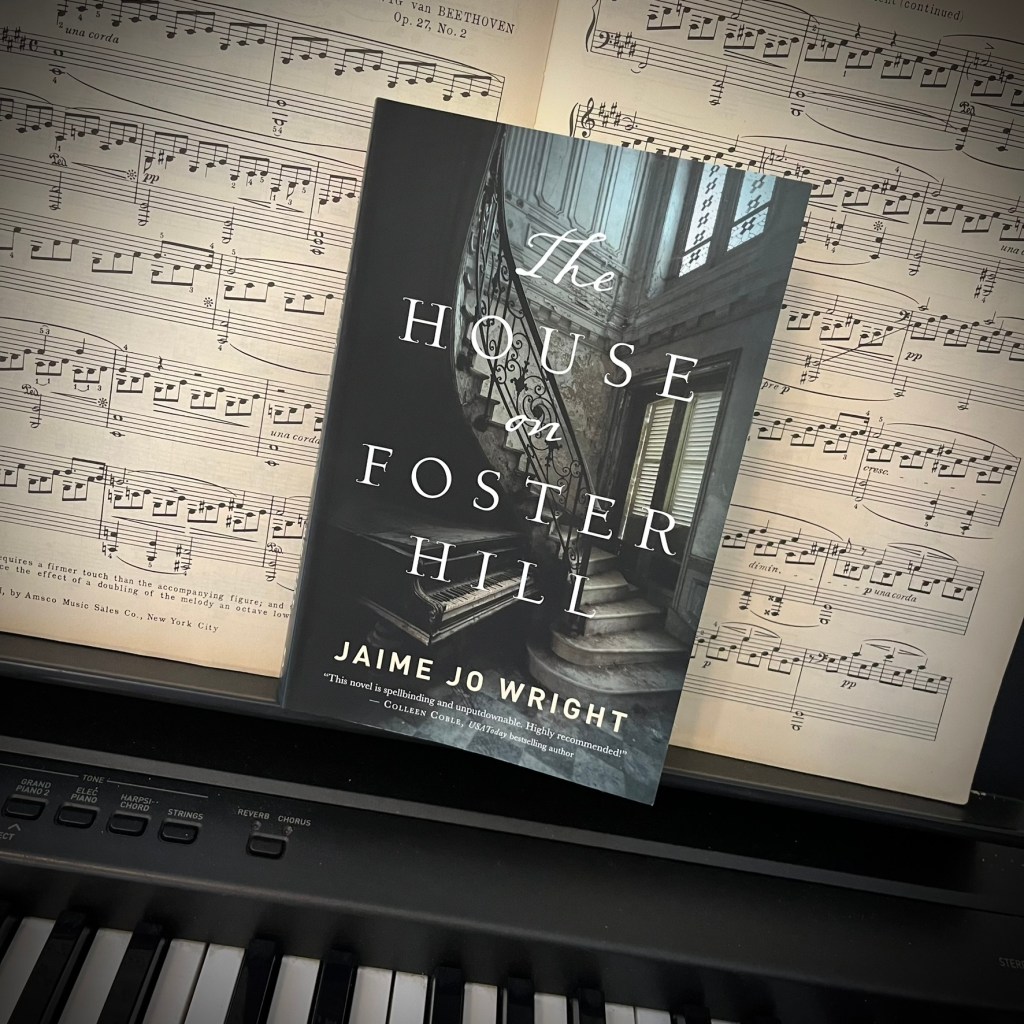
Overall, I highly recommend Jaime Jo Wright’s first novel, The House on Foster Hill. Whether you’re interested in suspense, romance, small-town life, or simply Christian fiction with deep, real topics and themes, this book offers a good and powerful read.
As with The Souls of Lost Lake: come for the suspense, stay for the story.
 Melissa J. Troutman