I knew I wanted to read this book even before I read it. A preliminary scan of just a few random pages was enough to get me excited—yes, excited—to sit down and officially start this gem. And I wasn’t disappointed. Within the first few chapters, I realized what a precious resource this book is for a medieval kingdom-fantasy writer. I took six and a half pages of notes and, before I even finished the book, bought my own copy. I have since re-read it, at least once, with highlights and in-text notes.
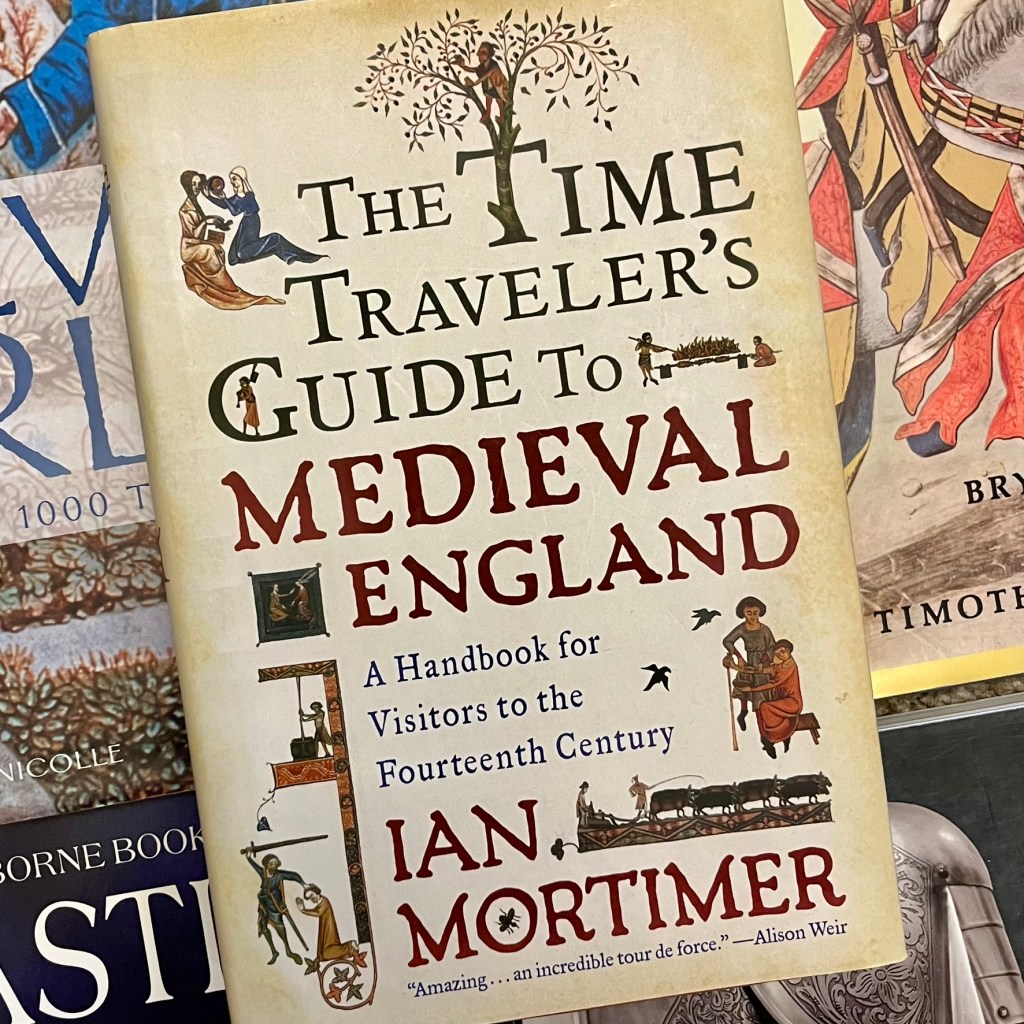
Even if you’re not writing kingdom adventure set in a medieval world, you will enjoy this book for six reasons:
1. The approach
Mortimer approaches history with a different view from other writers. He explains in the prologue, “As soon as you start to think of the past happening (as opposed to it having happened), a new way of conceiving history becomes possible. . . . [A] travel book about a past age allows us to see its inhabitants in a sympathetic way: not as a series of graphs showing fluctuations in grain yields or household income but as an investigation into the sensations of being alive in a different time” (1).
It is these sensations of being alive that Mortimer gives us on his tour to the Middle Ages. He treats his book as a guide to a current country, pointing out details, beliefs, and descriptions that bring the medieval times to life. You are not forced to sit in on a lecture explaining what happened and why seven hundred years ago. Instead, you are taken with the author as he walks (and rides and sails) through the living, breathing Dark Ages.
Mortimer’s unique approach to history alone fills the pages with enough interest to keep you pegged from prologue to epilogue.
2. The word pictures
The first chapter welcomes you with this sentence in its first paragraph: “The hundreds of houses appear tiny, all at chaotic angles, and of different shades and hues, as if they were so many stones at the bottom of a stream flowing around the great boulder of the cathedral” (7). Later on in the same chapter you’ll read this: “Yes, the houses appear to have been scattered all over the place, as if each toft were a giant playing card from a pack that the Devil once tossed over his shoulder in a fit of pique” (30-31).
Despite being a visual learner, I easily get lost when books launch into descriptive paragraphs. (Guess it’s due to my bad nonexistent sense of direction that I can’t follow or picture anything from such a maze of words.) With word pictures like these, however, I can imagine the setting in an instant. It’s a good writer who can help the reader see the invisible by linking it to the visible. Mortimer uses such simile and metaphor often, guaranteeing an easy read for everyone.
3. The new words
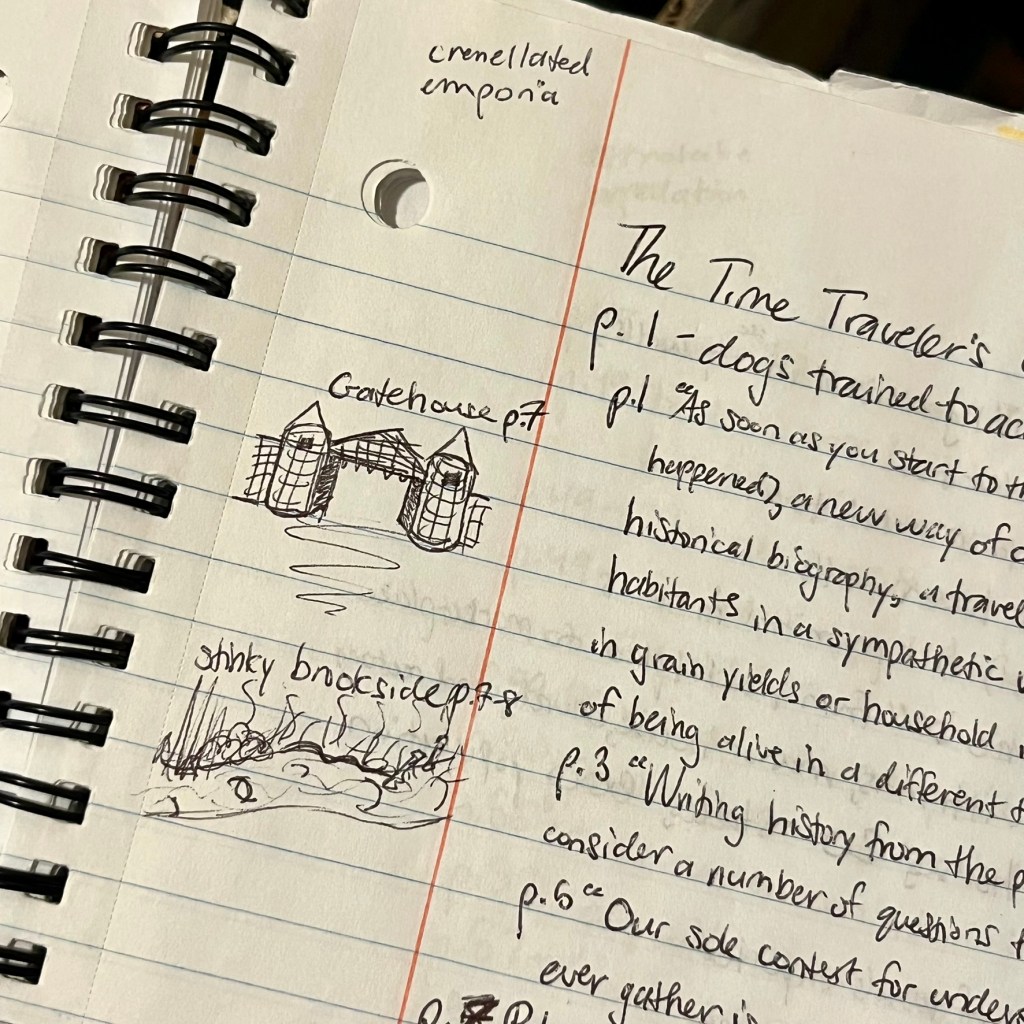
Along with notes for my worldbuilding, I kept a list of words for my personal vocabulary. Some of them were from the medieval vocabulary. The rest were just good words that I hadn’t seen before. Mortimer endeared himself to this word collector by scattering several new jewels throughout his pages. I found, I took, and I treasured.
4. The documentation
It sounds silly, but I appreciated the documentation in this book. The last twenty-eight pages are dedicated to notes, works mentioned, and sources. The author did his research, he did thorough research, and he credited his research, none of which is to be taken for granted. Well done, sir.
5. The wit
While humor endears any type of book to readers, it is perhaps most appreciated in non-fiction, where supposedly there isn’t much else to interest the reader. I found Mortimer’s casual wit the frosting on the cake in his masterpiece:
“A vintner caught selling foul wine is dragged to the pillory on a hurdle, forced to drink a draught of the offending liquor, and then set in the pillory, where the remainder of the liquid is poured over his head. The sweetness of revenge makes up for the sourness of the wine.” (95)
“The body of the tunic remains loose; it hangs from the shoulders with as much grace as the wearer can give it.” (107)
“In the 1330s the toe begins to grow. And grow. On both sides of the Channel noblemen seem to be in competition to wear the longest shoe.” (110) (Cheers to the writer who can make amuse a reader with medieval shoe fashion.)
“On a galley in the Mediterranean, where most people sleep on deck, you have to climb over all the people to reach the seats at the prow during the night. . . . If you fall overboard while using one of these facilities, it will be the last mistake you ever make. You will have been, literally, ‘dying for the toilet.’” (141-142)
And these are just a few. If I had more time and space, I would treat you to more examples of Mortimer’s wit. (My solution is that you buy the book. You will then discover all of Mortimer’s humorous turns of phrase for yourself, some of which I promise will make you laugh out loud.)

6. The involvement
“If you, a stranger in this country, are seen in a village at the same time as a burglary is discovered, and the hue and cry is raised, you might be arrested by the local people. You will then be handed over as a suspected felon to the local tithing-man and constable who will personally take you back to your home village and hand you over to the local constable there. . . .” (223)
This is just one example of another approach unique to Mortimer’s style: his involvement of the reader. His book is not a passive tour guide. It is an active role-play in the medieval world. Such use of the second person not only involves the reader personally but also makes the situation easier to understand.
The above excerpt is from the chapter on law and justice, where the first several pages covered explanations and descriptions from the distant third person. I was lost. But as soon as Mortimer turned to second person and put me in the situation, I understood it. The author won my gratitude by not just showing me but also including me in the medieval world.
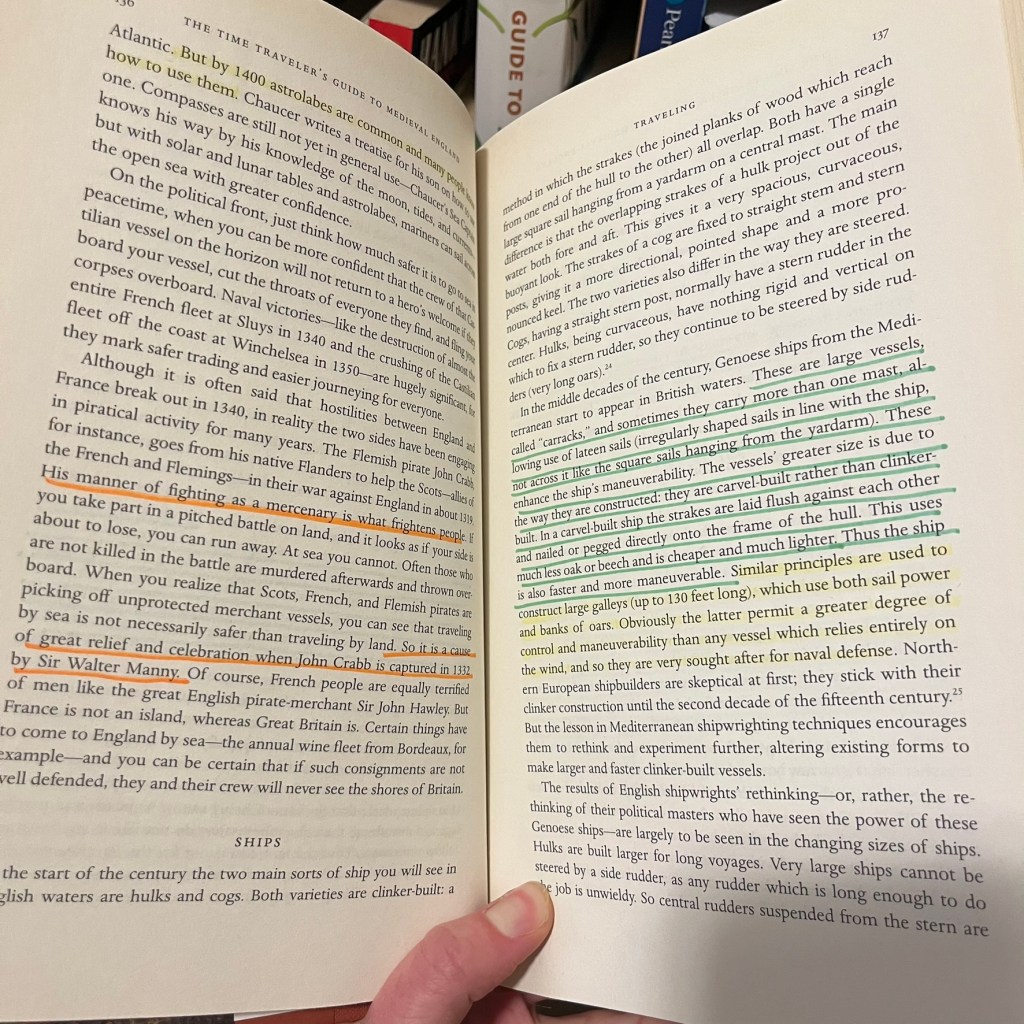
As a fair warning, this book does use adult language, on a few occasions, and cover adult content. So despite its fun and easy reading, I wouldn’t hand it off to a young reader without advising them against the few mature sections.
Overall, I am beyond delighted to have this book among my collection. I enjoyed the first few reads and look forward to the next. As a writer, Mortimor has won himself into my Author Hall of Fame with his information, wit, and general writing style. So whether you’re a writer, a history buff, or a lover of good literature, read this book. You will learn so much, and (believe it or not) you’ll even have fun along the way.
 Melissa J. Troutman