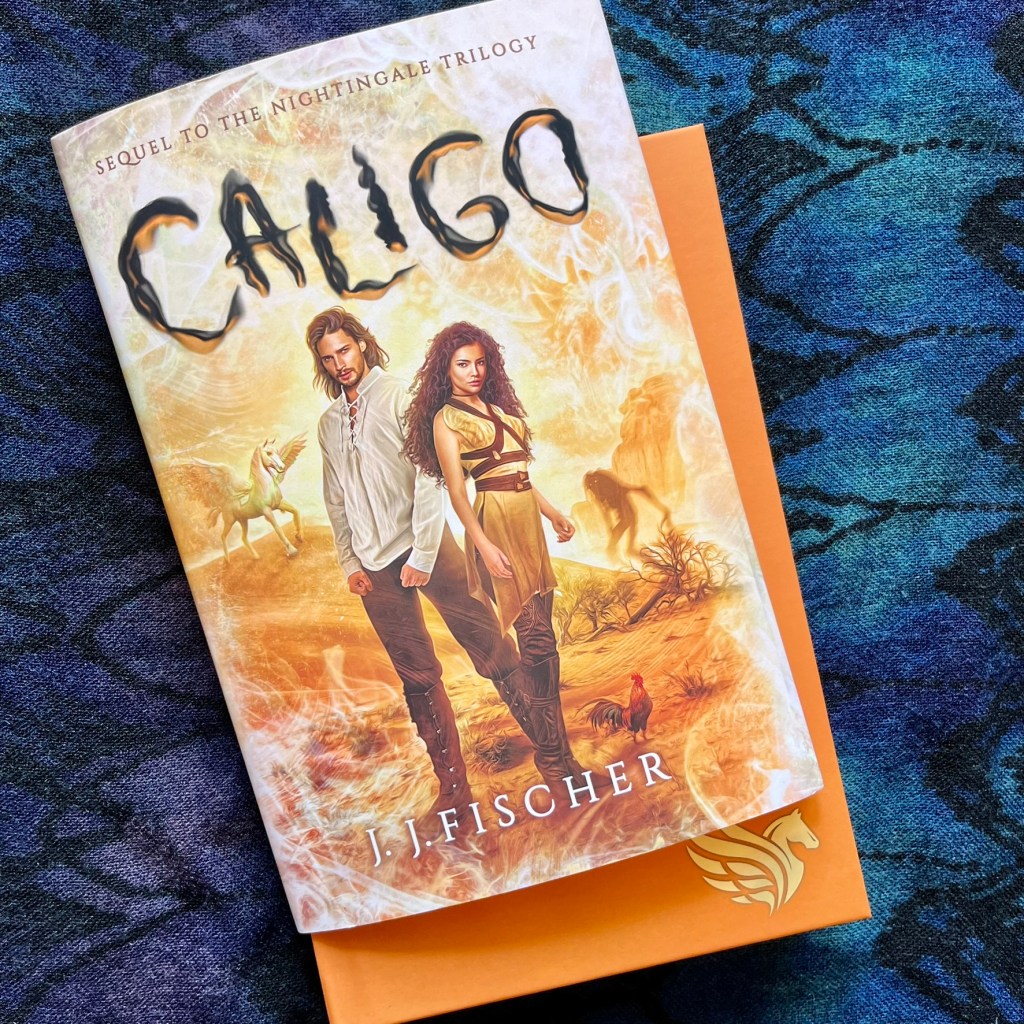
J. J. Fischer’s newest book, Caligo, released this month, and I could not be more excited to share this review with you. (If you haven’t read The Nightingale Trilogy, read with caution, because I couldn’t avoid some vague spoilers of the last book.)

Don’t get me wrong, I LOVE a series like The Nightingale Trilogy: the epic, complex stories that need a few volumes to tell with full justice. But there’s also something to be said for the contained story of a single novel—in the case of Caligo, a novel that has the same depth of character and story and themes as an entire trilogy, only delivered in a single meal rather than a multi-day banquet.
So if you were to ask me which I like better, The Nightingale Trilogy (featuring Calor, Lumen, and Memoria) or its sequel standalone, Caligo, I honestly don’t know if I could choose between the two. They’re on the exact same level of the same shelf, albeit in different categories. So please don’t ask me to choose.
Instead, let me tell you why I loved Caligo ALMOST more than The Nightingale Trilogy:
Cass
If you’ve read The Nightingale Trilogy, you know Cass’s character: sharp-witted, sarcastic, more than a little charming (gotta love that devil-may-care attitude), and, deep down, with a good heart beneath the flirting and, um, sometimes questionable morals.
Now imagine a whole book of Cass. Yes, that’s right. An entire, 100,000-word book rich with Cass’s glib wit, droll comments, and laugh-out-loud one-liners. Yet before you hesitate over Cass’s flaws, know that this Cass is not the same Cass of the trilogy; that surface charm has been worn thin, almost away entirely, by hurt from a woman’s rejection and the reality of his own mortality, showing us a humbler, more serious, and even frightened Cass beneath.
From conversations in Lumen and Memoria, it’s not a surprise that his time in love, ill-fated as it may have been, was good for Cass. He says so in his own words. What DID surprise me was this next story: where he goes after watching the woman he loves marry another, and how he comes to terms with himself, his gift, and his curse. To say more would be to give spoilers, so let me put it this way: this story is as authentic to Cass’s character as it is to Fischer’s writing. It’s perfect, believable, thought-provoking, and satisfying.
Zaire
Cass as one POV character makes this book great already. What also makes it great is the other main POV character: Zaire Delmar. I won’t say too much about why she’s in the book, because that would spoil what you’ll learn for yourself in the first few chapters. But I will say she’s the perfect counterpart—perhaps the perfect main character—for this story. Exotically beautiful in one form, terrifyingly powerful and ruthless in another. Which one is the real Zaire?
It takes a lot of story—adventures, dangers, encounters, struggles, and other characters—to help Zaire learn more about herself and, like Cass, understand how to move on beyond her past. She faces hurt and vulnerability that any reader can relate to, and her own journey toward truth will resonate with—and offer hope to—many readers as well.
As for the other part of her story, well, let’s just say Cassius Vera has met his match at last. 🙂 I really liked the way their stories intertwine, with more fire and grit than Sephone and Dorian, less introspection and internal angst, and more boots-on-the-ground action as these main characters deal with each other and face events together. Their forward momentum is gradual, natural, and with plenty of (also natural) steps back along the way. By the end, though . . . it couldn’t be more perfect.
The Other Characters
I don’t want to say much here either, because I want you to enjoy the same surprise and delight I did the first time I read Caligo. But know that Cass and Zaire are not the only characters from the trilogy you’ll see again in this book. Some you’ll like, some you won’t, but they all deepen the story—and have their own stories deepened—in authentic, believable ways.

The Themes
Where do I even start? Part of what makes Caligo a powerhouse of Christian fantasy, true to J. J. Fischer’s style, is its depth of theme. And not just one theme, but several. Let me try to tease apart these interwoven threads so you can admire them in the laboratory light of a book review—though trust me, you’ll appreciate them much more in their natural place embedded throughout the story when you read it.
One theme explores the various facets of human relationships and their role in the human heart: what it means to be strong, to be weak, to be independent, to need others, to love, to be loved. Cass and Zaire balance this theme well as they respectively struggle to understand the truth, beauty, and freedom of wholesome relationships with good people (romantic and otherwise), compared to the lies they’ve told themselves and have been told by others. Many readers will relate to and find encouragement in these layers of the story.
Another theme relates to the monstrosity of humanity, in ourselves and in others, and facing and overcoming our pasts. Cass isn’t perfect. Neither is Zaire. (Neither, in fact, is any other character in this book. Well, Aedon, but as one of the Infinitum, he doesn’t count.) Both these characters must come to terms with what they’ve done and choose how they’ll respond to the actions of others. Caligo portrays honestly some deep darkness of the human heart, while also showing the light of hope and redemption that cannot come from ourselves. This light gleams more brightly through the pages of Caligo than in most other Christian fiction I’ve read.
A final theme I took from this book is somewhat related to the first, couched in the specific context of feminism. Again, I won’t give details because I don’t want to spoil your reading experience, but suffice to say, the Virago aren’t just a group of women fighting to survive; they’re a cult, paralleling the false doctrine, deceit, and gross crimes of today’s extreme feminism. While these women despise men and call them oppressors, throughout the entire story (this makes me want to cheer) we see strong male characters acting in kindness, compassion, sacrifice, loyalty, gentleness, and love, while also wielding weapons and fighting monsters and being handsome—not-so-subtly challenging this false view of their sex. I LOVED reading these men as protectors, defenders, and strong companions to their female counterparts, portraying the beauty of God’s design for the different genders. (I read Caligo while I was finishing Rosaria Butterfield’s Five Lies of Our Anti-Christian Age, and the two books could not have been more complementary.)
One last note: while The Nightingale Trilogy explores the theme of sorrow, its cost on those who carry it, and the way Aedon can relieve it, Caligo delves even deeper into these ideas through Cass’s personal character journey. When Aedon (a representation of Jesus) visits Cass for the last time in the dark grime of his prison cell . . . I cried. It was so beautiful, so powerful, so intimate, so gently true to Scripture’s depiction of Christ as the man who bears our sorrows. Even though our world doesn’t have the magic gifts of Fischer’s imagined lands (more’s the pity), I borrowed this visualization into my own relationship with Jesus, and it really ministered to me in a time of hurt.
(THAT is one of the best gifts of Christian fiction. J. J. Fischer, you need to come up with a name for your gift of writing Christian truths in such creative, beautiful ways. A lewiseum? A jam, short for jamais-vu? A scribeus? There has to be something, because what you do is truly a gift, better than any gift in Cass’s world.)

So there you go. If you’ve read and enjoyed The Nightingale Trilogy, you’ll love Caligo. If you’ve never heard of The Nightingale Trilogy, you’ll also love Caligo—you don’t need to have read the trilogy to understand and enjoy this standalone sequel novel.
Now that I’ve written this review, don’t tell anyone, but I think . . . *hides behind Caligo and whispers* I think the scales have tipped just a little in favor of Caligo. Seph and Dorian are great and all, but give me Cass and Zaire—and their featherduster—any day. 🙂
 Melissa J. Troutman