While perhaps best known for his award-winning YA fantasy series, The Chronicles of Prydain, American author Lloyd Alexander wrote many other books, among them an obscure but no less enthralling series called The Westmark Trilogy.

The first book, Westmark, introduces us to a young man named Theo in a European-like kingdom named Westmark, reminiscent of the late eighteenth or early nineteenth century. When the Chief Minister’s new orders leave Theo without a master or a livelihood, and almost without his life, Theo joins up with a charlatan doctor, his dwarf coach driver, and a mysterious street girl. Together these companions try to make ends meet while avoiding trouble, only to end up at the very heart of the Chief Minister’s plot against the kingdom.
The Kestrel takes us deeper into Theo’s psyche and the soul of war itself as violence from its people and its neighboring kingdom, Regia, tears Westmark apart. Bloodshed reigns, alliances form, enemies attack, traitors and friends come and go on both sides, and in the midst of all, Theo sets out to find himself only to risk losing everything he’s become.
The saga concludes in the final book, The Beggar Queen, which reads the most like a novel of the French Revolution with its power imbalances, guerilla companies, spy networks, and allegiance shifts. Theo once again takes up the leadership he never wanted, to face the enemy he never killed, paying costs both expected and unexpected to protect his kingdom, his friends, and the woman he loves.
The eye of the cannon studied the barricade with an unhurried, appraising glance. The gunnery sergeant gave the order to fire. There was a shattering explosion, the eye burst suddenly into flame. The cannonball plowed into the mattresses and hay bales. The barricade gasped and shuddered. Some of the cobblestones were jarred loose, but the breastwork held.
~The Beggar Queen, Chapter 22
I’ll tell you now, these books are a bit gritter than Prydain, with more violence (though not graphic) and more human darkness than the lighter-toned fantasy cycle of Prydain. I wouldn’t hand these books to a young reader.
I will, however, highly recommend the Westmark books to teens and up. The quick version of why I love these books is because of their
- coming-of-age themes
- non-stop action
- plot twists and intrigue
- dry wit and humor
- lively, varied characters
- relatable hero
- spunky female lead
- moral questions
- (very) light romance
- cinematic writing
- presentation of good vs. evil

Let me park on a few of these elements.
The plot twists and intrigue. If you like the books where certain elements seem random until they suddenly coincide with each other, or in a larger picture, you’ll love the Westmark books. Throughout the entire trilogy, no detail, character, or event is wasted. Someone or something will show up once only to show up again later, or the story will appear to double back on itself until it opens up into a “gotcha” revelation, or a minor character will end up with the major role. The plots, the counter-plots, the schemes and politics and strategies oh my . . .
The (very) light romance. Don’t get me wrong, I appreciate a well-written romance, but these are hard to find (and are often inappropriate) in YA literature. If you want to read a good YA story that isn’t heavy on romance or angst or relationship tropes, these books are for you. The first book, in fact, never uses the words “love,” “heart,” “feelings,” or “romantic,” but it’s clear—and cute—what’s going on in the wings. While this relationship deepens in the second and third books, it remains peripheral to the main story.
The moral questions. The Westmark books, especially The Kestrel and The Beggar Queen, will make you think. Drawing from his own experience in Europe during WWII (hence the realistic settings, events, and emotions, and likely some of the place/ethnicity names), Alexander probes deep into the glories and agonies of war. What is right, and who do you become, when evil threatens your kingdom and your loved ones? What is the difference between right and wrong in time of war and revolution? Though The Westmark Trilogy stirs up many of these questions, I believe the characters’ actions and reflections make clear to the reader the difference between good and evil.
He was not sane enough to realize he had gone somewhat mad; he had only gone mad enough to believe himself completely sane.
~The Kestrel, Chapter 12

The cinematic writing. I don’t know how else to describe Alexander’s writing style. The descriptions, the shifts of perspective, the action, the moments dwelt on in the moments passed over—I felt like I was watching a movie. I could visualize exactly what was happening, or being described, or being felt, all because of Alexander’s tight, rich writing. (See more below.)
He glanced up to see Florian. He was on horseback, a smoking musket across the saddlebow. His long hair hung matted, smears of gunpowder blackened his cheeks.
~Westmark, Chapter 17
The dry wit and humor. True to Alexander’s style, you can expect some fantastic sharp wit from the characters, along with fabulous dry humor from the narrative itself. (I think Alexander’s wit shines more in the narrative of Westmark than in Prydain, despite Westmark’s darker content.) You only have to start reading the first chapter of the first book to get a taste of the humorous tone common throughout the trilogy.
Theo, by occupation, was a devil. That is, he worked as apprentice and general servant to Anton, the printer. Before that, he was lucky enough to be an orphan, for the town fathers of Dorning prided themselves in looking after their needy. So, instead of sending him away to a King’s Charity House, where he would be made miserable, they arranged the same for him locally. He was farmed out first to a cooper, then to a saddler . . .
~Westmark, Chapter 1
The lodging house at the end of Strawmarket Street stood as one of the marvels of Freyborg: the marvel being that it stood at all.
~Westmark, Chapter 12
“You are one of the few who do not employ the service of leeches. Very sensible, since we already have a large one disguised as a chief minister.”
~Keller, Westmark, Chapter 14

Finally, I want to take a moment to appreciate some aspects of these books that showcase Alexander’s skill as a master writer:
First, how much he says without saying much. The mark of a master writer is his ability to communicate a lot with a little, and Alexander proves himself a master of masters. He writes with enough description to jog the imagination and let it do the rest. You can get more from Alexander about a character in one sentence—or about a setting in a few lines—than you can get from most authors in a paragraph.
Second, the never-ending story tension. From start to finish of each book, the “loop” of action, twists, and intrigue never closes, staying open from one scene or chapter to the next, or with another loop opening before the current loop can close. Either way, there’s no pause, not a single lull, no chance at all for the reader to even consider getting bored. Alexander holds off on full closure—and often closure of multiple “loops”—until the very end. So once you’re in, hold on—you’re in for the whole ride, and it’ll go fast.
Third, the art of the scene. Alexander crafts each scene like a mini story, with a hook, a middle, flow and tension, meaning, and a clinching end. Whether half a page or an entire chapter, one scene in The Westmark Trilogy has more intention and good writing than some authors have in an entire book. If you want to study the scene as a unit of expert storytelling, look no farther than Lloyd Alexander in The Westmark Trilogy. (I want to write like him when I grow up.)
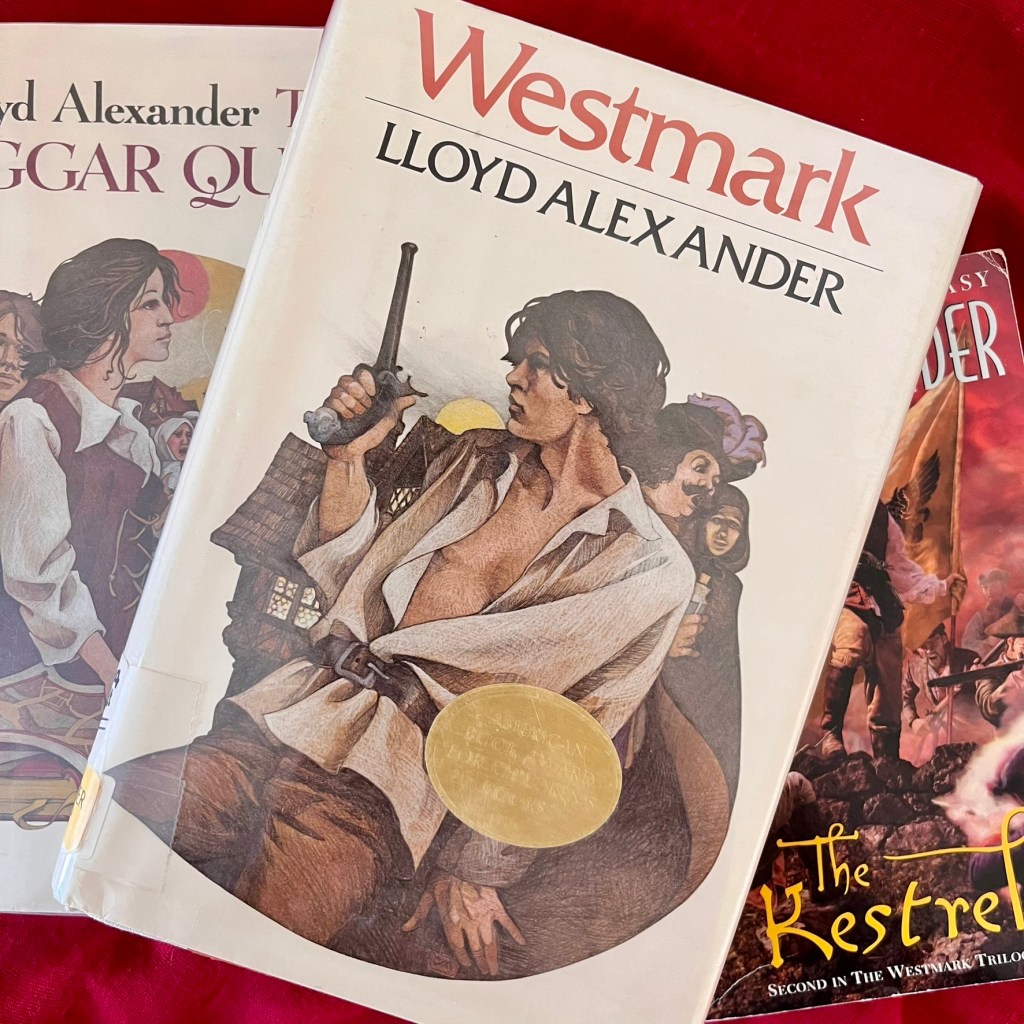
Together it’s these stories and their writing—along with the humor, the characters, the questions, and all the other things I didn’t expound on—that make The Westmark Trilogy another five-star series from, in my opinion, one of America’s best and most underrated children’s fantasy authors. Whether in the fantasy realms of Prydain, the lifelike kingdoms of Westmark, or the lands of one of his other stories, I hope you enjoy Lloyd Alexander’s masterful storytelling for yourself—sooner rather than later. 🙂
 Melissa J. Troutman