
A Little Bit of Background
The first time I read the Little House on the Prairie books, I was Laura’s age, in elementary school. I remember liking the stories as pleasant, if a little boring at times, though I thought the last book (The First Four Years) was weird because the guy was now called “Manly” rather than “Almanzo,” and my confused little-kid brain thought it was a completely different person. I don’t remember if I actually finished the book.
This summer, I was looking for a light series to listen to, so I pulled up Little House in the Big Woods and began listening—just in time before my college friend and Little House aficionado/influencer from Wisconsin came to visit. (We did listen to some of the audiobook together during our car trips.)
I concluded this series of adventures in late October, and the bittersweet feelings at the end of Laura’s journey, looking back over the years of her life chronicled in these stories, surprised me.
Immersed in Cherry Jones’s delightful narration, I grew with Laura through her childhood, first in the snug cabin in the Wisconsin woods, then on the wagon trail west to Indian Territory, then in the pretty little house Pa built on the prairie, followed by the dugout on the banks of Plum Creek in Minnesota, next in the borrowed house on the shores of Silver Lake in South Dakota, and then in the claim shanty and the townhouse a few towns over, where Laura grows into a young woman—first an independent young woman who becomes a teacher, then a courting, engaged, and married young woman who becomes a mother.
If you’re an adventure-seeking reader like me and hesitate to read (or return to) the Little House series because “nothing happens,” believe me, everything happens. Life happens, in all its ups and downs, joys and sorrows, hardships and rewards. I was surprised how invested I was in the Ingalls’ lifestyle, for as simple as it is—though in reality, it’s not at all simple.
You may not have the epic-scale quests and adventures and battles of good vs. evil, but you have quest after quest for space and freedom and land to call one’s own.
You have adventures on the trail, along the creek, in the farm fields, or even inside the house’s big room with siblings, neighbors, dolls, animals, insects, storms, and haystacks (to name a few).
You have the quiet but no less momentous battles of self vs. others, right vs. wrong, as Laura learns virtue and morals.
And you have one of the most despicable villains in children’s literature: Nellie Oleson. (Raise your hand if you also hate her guts.)

A Little List of Recommendations
Especially if you have kiddos, here are some of my favorite reasons to read (or listen to) the Little House series together:
- the onomatopoeic writing that brings the settings and the events to life
- the simple elements of good living: hearty food, regular music, close-knit family, loyal friends, hard work, and gracious hospitality (identical to the backbone of my childhood favorite Redwall series)
- the examples of grit and hard work, whether during travel, on the prairie, in town, or on the homestead
- the themes of resilience and acceptance of hardship (see more below)
- Ma’s wisdom
- “All’s well that ends well”
- “Least said, soonest mended”
- “There’s no great loss without some small gain”
- “We’ll cross that bridge when we come to it”
- the portrayal of wholesome family life: Pa’s fiddle, Ma’s cooking, Mary and Laura’s friendship, all their support for and kindness toward each other, and the predictable rhythm of chores, play, and society
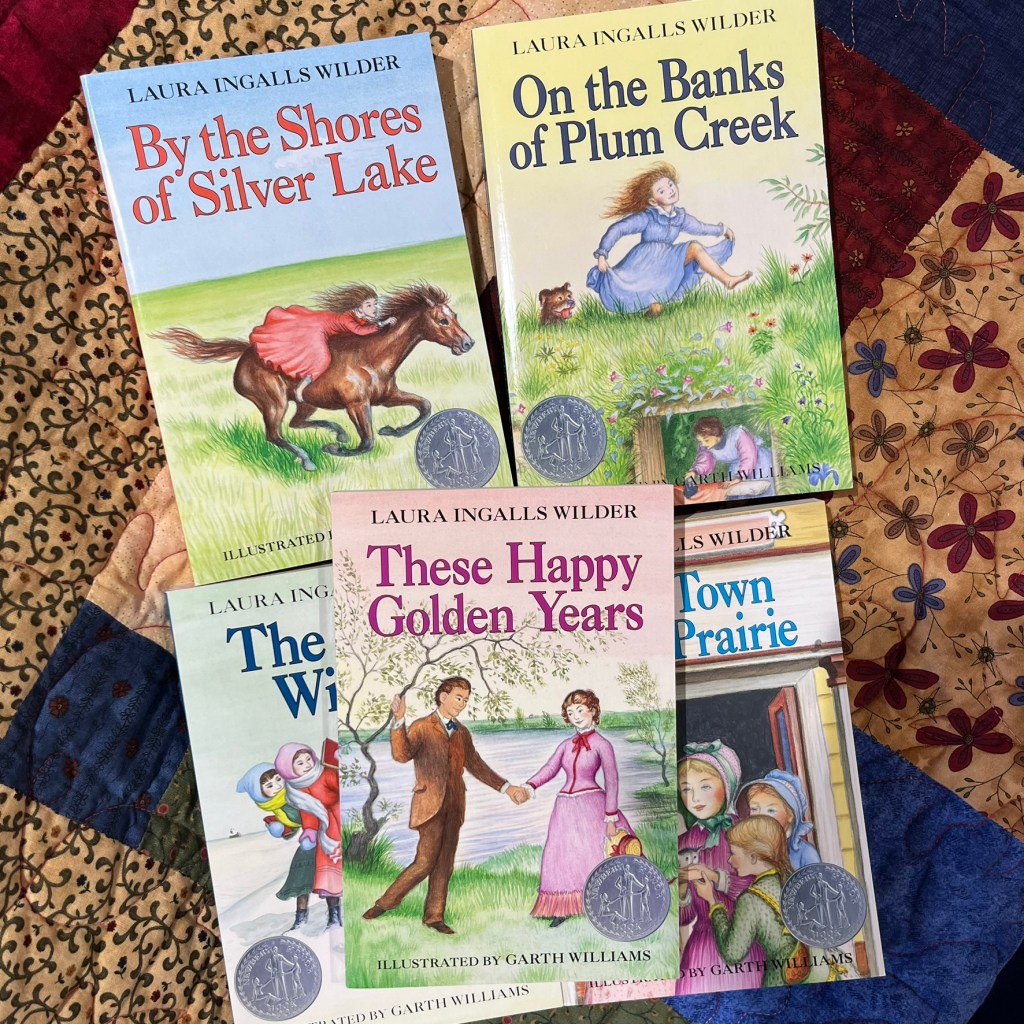
- On the Banks of Plum Creek, By the Shores of Silver Lake, The Long Winter, Little Town on the Prairie, and These Happy Golden Years are all Newbery Honor books
A Little Series of Reflections
I come away from this series with several general impressions (in no particular order):
I am a wimp. As I listened from my air-conditioned Nissan cruising down the highway at 80mph or in my multi-blanketed bed in my own spacious room, or while cooking in a modern kitchen with ingredients from a stocked cupboard and running refrigerator, I had nothing but admiration for these families who lived and worked in conditions I can’t even imagine: driving a sleigh to pick up your beau in negative-sixty-degree weather, twisting hay into stove fuel and grinding wheat in a coffee grinder ceaselessly throughout the day just to stay warm and fed in a blizzard, building yet another house for your family with your bare hands under the summer sun, doggedly doing chores and helping neighbors and finding work no matter what the weather, economy, or government bring. These books are a study not just of the American dream that so many people still come West to find, but also of the grit, backbone, and character that alone make that dream come true.
Laura and Almanzo’s courtship and marriage (These Happy Golden Years)were so sweet and wholesome, even (especially?) without the details typical of romance literature. While at times I would have loved to be more inside Laura’s or Almanzo’s head during their courting years, I also found it refreshing to witness their relationship building in a quiet, natural way without the play-by-play commentary on all their thoughts, struggles, and emotions. I believe YA literature needs to bring back more relationships like theirs.
I was touched by Laura’s drive to work, whether in sewing or as a teacher, to earn money to help pay for Mary’s education at a college for the blind so that her sister could live a fulfilling life despite her physical handicap (These Happy Golden Years). This is seflessness, and sibling love, at its finest.
I was inspired by Ma’s creativity and adaptability, especially during the poverty and anxiety of The Long Winter. (This book seriously stressed me so much.) From making button candles to hanging clean curtains, from faithfully preparing their daily food rations to selflessly entertaining her girls during low moments, Ma reigns as the empress of making the most out of little, both materially and emotionally. (Next time I jury-rig or invent something out of scarcity, I’m going to say I “Ma from Little House”d it. :))
I want to start a town literary society (as shown in These Happy Golden Years). Anyone else want to join in?
I was amazed at how early young Almanzo was taught and entrusted with responsibilities (even if modified) in Farmer Boy. Nine years old when he started training his own little team of heifers. Then driving with his father and neighbors to bring back logs from the forest. All four children left alone for a week while the parents went on vacation. Allowed to miss school to help on the farm. What a different generation (and lifestyle) of raising children: letting them still be children while also equipping them, early and thoroughly, for life ahead.
Yes and amen to all the fresh air, running around barefoot, playing with animals, forgetting (or avoiding) your sunbonnet, helping around the house or the farm, learning skills from your parents at an early age, and enjoying and stewarding God’s beautiful, wild creation.

A Little Connection with Philosophy
What do Stoic philosophy and Little House on the Prairie have in common?
Hang tight and I’ll share with you one of my biggest takeaways from this classic children’s literature series.
At the end of August, when I was almost halfway through the series, we had a team-building exercise at work that included discussing and labeling issues (at work and otherwise) according to the circle-of-concern-and-circle-of-control model. As our workshop leader walked us through this model—identifying the things that concern us and then things we can control or do—I couldn’t help thinking of Pa in Little House on the Prairie and On the Banks of Plum Creek. I jotted down a whole outline of these book events and how they demonstrated this model, then two months later forgot I had that outline on the backside of the handout and threw it away. (This is why I never throw papers away . . . at least without triple-checking them first . . .)
So I turned to the internet to refresh the concepts of this model, and spent the rest of the evening nerding out about the multiple connections to recent conversations and resources (such as some key elements of my current read, The Coddling of the American Mind by Greg Lukianoff and Jonathan Haidt, and echoes from David Brooks’ How to Know a Person which my students are reading and discussing in class).
You can glance through this article from Positive Psychology on your own to get an idea of this framework. I’m going to borrow their chart to show you what I’m talking about:
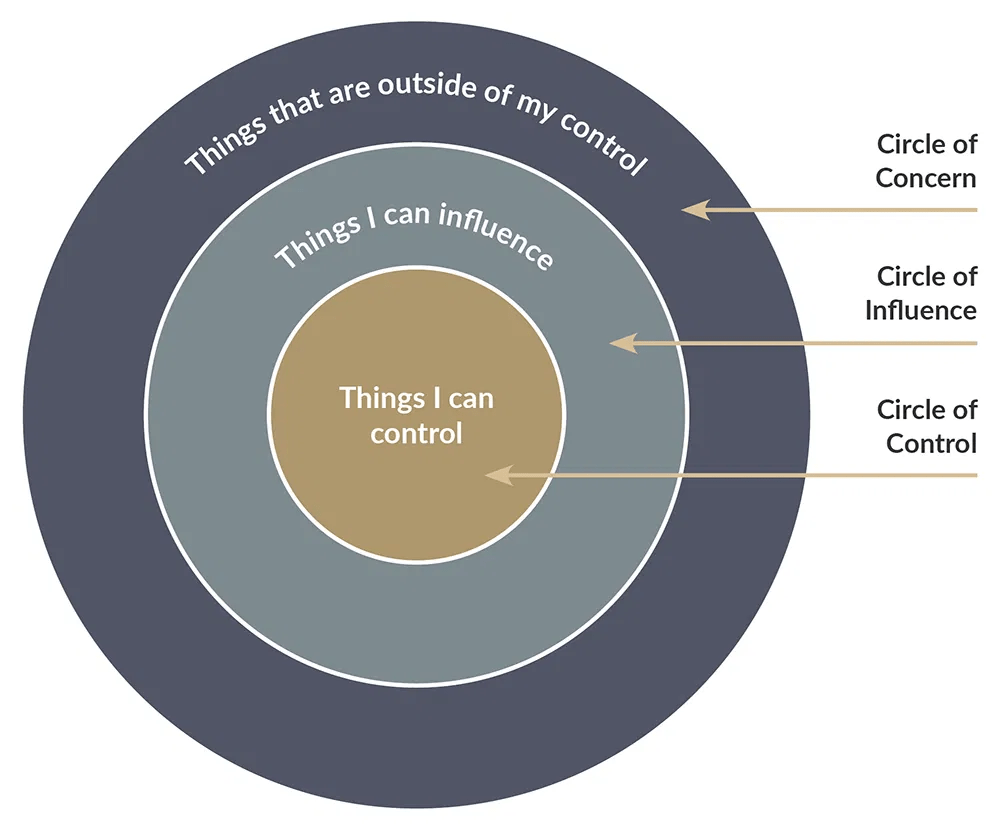
I’m also going to borrow just a few quotes to break down this chart and how it relates to Pa Ingalls:
Most philosophers and psychologists agree that this [center circle, the circle of control] encompasses our inner lives: our thoughts, beliefs, emotions, interpretations, and judgments of external events. We should try to focus most of our attention, energy, and resources on this region. . . .
The third and largest, outermost circle in the diagram represents the circle of concern. This circle encompasses a broader range of external factors, challenges, and circumstances that we may care about but which are clearly beyond our control.
This circle includes the economy, climate, and weather . . . Ryan Holiday (2016, p. xi) puts it succinctly: “We cannot control the world around us, but we can control our reactions to it.”
There are excellent reasons for applying this model in our own life. For example, Luthans et al. (2008, p. 132) established that “individuals who focus on the circle of control are more likely to be resilient in the face of stress and adversity.”
Back in the 1880s, when this series takes place, there was so much outside Pa’s control.
Life carried constant unpredictability, discomfort, and challenge to basic survival, with setback after setback in these two books alone:
- After a year of building a house and raising crops on their new land, Pa learns the government is removing settlers from Indian Territory (they live three miles over the border). So they pack the wagon again and leave their house, fields, and neighbors behind.
- When they trade their horses and covered wagon for oxen and a dugout house in Minnesota, the included crop is poor.
- Pa works the land and plants a beautiful, new crop of wheat.
- Just days before the wheat crop is ready to harvest, locusts destroy it.
- Without a crop to sell, Pa walks 300 miles east (one way) to work months away from his family.
- That spring, the grasshoppers hatch and eat everything that had been planted.
- Pa walks east for work again.
- Meanwhile, throughout these years, the family faces sickness, accidents, extreme weather (winter and summer), and threats from nature and man alike.
Talk about stress and adversity.
But also talk about resilience.
Look at Pa’s response to the grasshopper infestation:
“But I do know this, Caroline,” he said. “No pesky mess of grasshoppers can beat us! We’ll do something! You’ll see! We’ll get along somehow.”
On the Banks of Plum Creek, pg. 209
“Yes, Charles,” said Ma.
“Why not?” said Pa. “We’re healthy, we’ve got a roof over our heads; we’re better off than lots of folks. You get an early dinner, Caroline. I’m going to town. I’ll find something to do. Don’t you worry!”
In a Western, modernized culture that idolizes comfort (or is it control?), I have little to no understanding of this kind of adversity, nor of the kind of backbone it forms in those who weather it. A distant appreciation is all I can muster, and even that more from my imagination than my experience.
It makes me wonder what kind of character we would have, collectively as first-world citizens, if we removed so much control from the equation of our lives and opened the door to a little more (or a lot more) discomfort and unpredictability. If we returned our locus of control inward, to our own minds and emotions, rather than so much of our external environment. I wonder if in our pursuit to bring everything around us under our power, we’ve lost sight of the only power we truly have: our power over ourselves. (Which one lies at the heart of happiness, and biblical joy?)
In the face of the stress and adversity we do have in our lives, I’m challenged to be like Pa Ingalls, and Ma, and Laura and Almanzo, these simple heroes of children’s literature who continue to inspire another generation of explorers, adventurers, laborers, dreamers, and home-dwellers with their “good old-fashioned” morals, work ethic, grit, and resilience.
Sometimes the most inspiration for the future is found in the past. I’ll go back to the Little House series and the pioneer era for inspiration any day. And the next time I put on my apron in my kitchen, or dig my fingers into a little garden soil, or take on a challenging task, or face an unexpected turn on the wagon trail of life, I’ll pretend I’m Ma or Laura Ingalls from the Old West. I’ll embrace the small moments of peace and delight, put my hands to the work in front of me, accept what I can’t control, and choose the perspective I can control: one of gratitude, contentment, creativity, and trust in God.
And maybe, in so doing, I’ll blaze a little trail of my own.
 Melissa J. Troutman