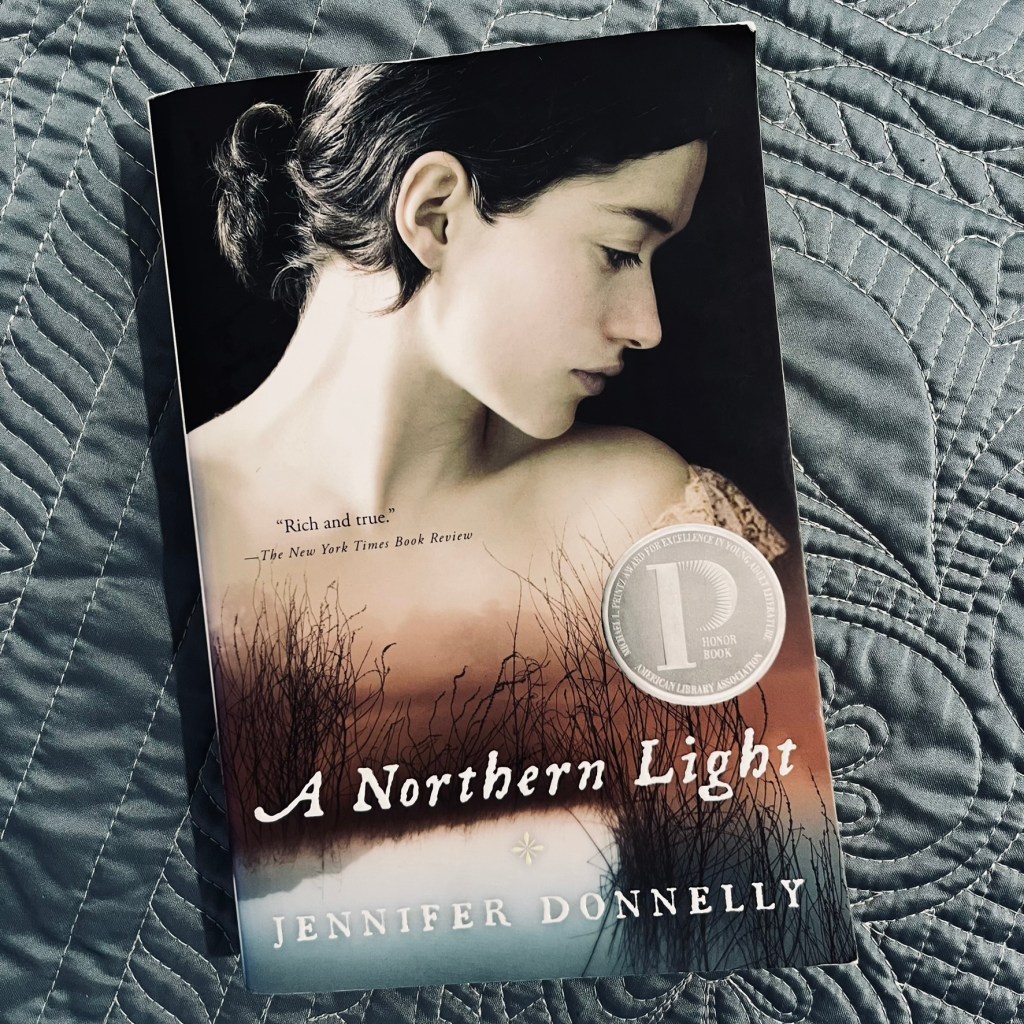
Published in 2003, A Northern Light by American author Jennifer Donnelly has won the Carnegie Medal, the L.A. Times Book Prize, the Borders Original Voices Prize, and a Michael L. Printz Honor—and in 2015 was named by TIME Magazine one of the best 100 YA books of all time.
It’s not hard to see why Mattie’s story has won awards, from both the reader’s perspective and the writer’s perspective.
The Reader’s Perspective
This story has two hearts: Mattie’s coming of age—finding her voice and making her way toward adulthood, even though she already seems too much of an adult at 15 years old—wrapped around Grace Brown’s mystery—a young heart lost to and broken by a selfish man.
As such, the story is split into these separate heartbeats, and while we never follow Grace as her own character, we follow two versions of Mattie: the Mattie before Grace’s body washes up in the lake and the Mattie determined to find out what happened to the drowned young woman.
“Pa, I want to ask you something,” I said, hope rising in me like sap in one of our maples, though I tried not to let it.
p. 23
It took me a minute to catch on to the dual timeline, but the change in writing tense—alternating chapters between past and present tense—made it easy to distinguish the separate timeframes of the story. It must have involved a stroke of genius (or two) to write post-Grace Mattie without giving away anything during pre-Grace Mattie.
It’s not every YA novel that revolves around a mystery, and Donnelly crafts her historical-fiction mystery exceptionally well. I suspected the culprit along with Mattie, and while I wasn’t surprised to learn the truth of what happened, I loved following the gradual discoveries that put together the pieces of Grace’s death.
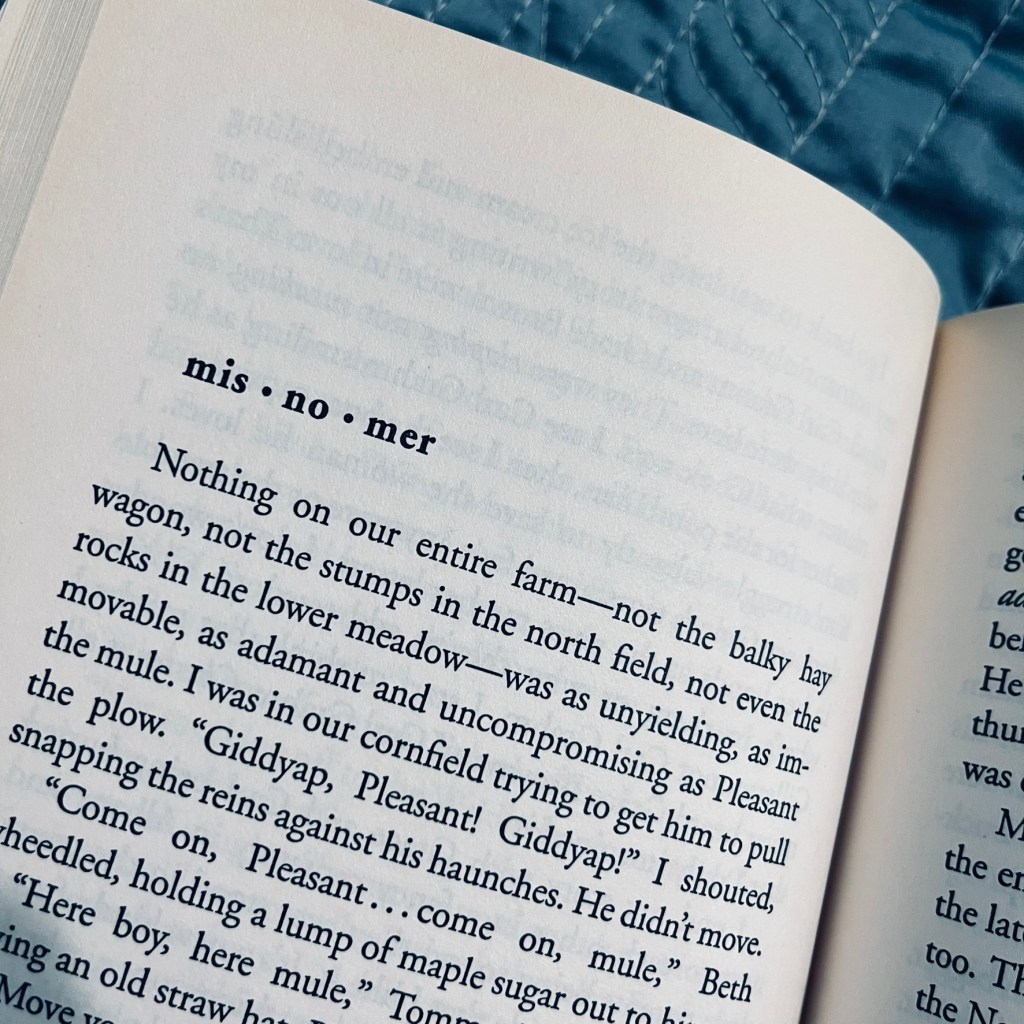
I also loved all the literary nods throughout the story. And the words. If you’re a reader, you’ll enjoy all the allusions to other books throughout, both classics that Mattie reads for school and then-contemporary fiction or poetry Mattie reads for fun. The words are the sweetest cup of tea for word-loving readers like me: most chapters start with Mattie’s “word of the day” and then weave that word into the story in the most ingenious way. The perfect marriage of vocabulary and story.
Then Will would snatch up a spider or a fly when Miss Wilcox’s back was turned. He was quicker than Renfield in Bram Stoker’s Dracula, though mercifully, he did not eat what he caught.
p. 58
In addition, I appreciated the character growth. Of course, Mattie is the primary character who changes. A Northern Light is full of things she learns—both good and bad—from the people and events around her. Her first crush (and kiss). A dead body. The joy and hope of writing. The promise of a future. The hardships of life that never end. Pleasing—and standing up to—the city people at the hotel. Making her own decisions.
But Mattie isn’t the only character who grows. While much less prominent, her father is one of the side characters who grow from start to finish as well, in simple, beautiful, unspoken ways. I won’t say more, because Donnelly says very little, but what she does say will move your heart.
I know I say this about a lot of books, but it was especially true of A Northern Light: I loved all the cultural details that bring authenticity to each page—details from food items and slang phrases to farm animals and fancy hotels. When telling a coworker about this book, I said the author had to have come from that area of upstate New York and lived those experiences because of how realistic they are. I believe Donnelly lived in upstate New York, and she documents her research at the end of the book.
Finally, I was impressed by how many relevant topics A Northern Light manages to address in the length of a YA novel. Feminism. Racism. Literacy. Independence. Familial love. Romantic love. A literary gem with various facets that catch the light of life as it is and blink it back to the reader without altering its hue.
I had to collect myself before I answered her. “Well, it seems to me that there are books that tell stories, and then there are books that tell truths . . . ,” I began.
p. 201
The Writer’s Perspective:
While I enjoyed this book as a reader, I also appreciated it as a writer. The Northern Light is a paragon of the best kind of writing, and I delighted so much in the artistic craft of this book.
One element of writing craft I loved was all the similes and metaphors used throughout the book. It’s these small comparisons and descriptions, couched in the setting and era of the story, that not only aid the reader’s imagination but also strengthen the story as a whole. This is the kind of creativity that turns storytelling from “decent” to “good.”
Our Abby is a sprigged dress that has been washed and turned wrong side out to dry, with all its color hidden.
p. 11
The other craft element of Donnelly’s writing is her subtext: what she says without saying it. Multiple times throughout the book I had to stop and either give an appreciative “ooooh” or simply put the book down to absorb the impact of what had just been communicated in so many words (or no words at all). This subtext is the apex of craft that turns storytelling from “good” to “great.”
Note: This book contains some mild or crude language and mild sexual content that is clear but not graphic (Mattie is touched, a hotel guest exposes himself, Mattie sees a couple in a sexual act). So if you’re considering this book for a younger reader, I advise discretion.
As a whole, Jennifer Donnelly’s A Northern Light reminded me of Belle’s character from Beauty in the Beast, with Anne of Green Gables’ love for words, set in Little House on the Prairie, with a touch of theme from The Outsiders. As both a reader and a writer, I enjoyed this award-winning YA historical-fiction mystery novel and gladly recommend it.

