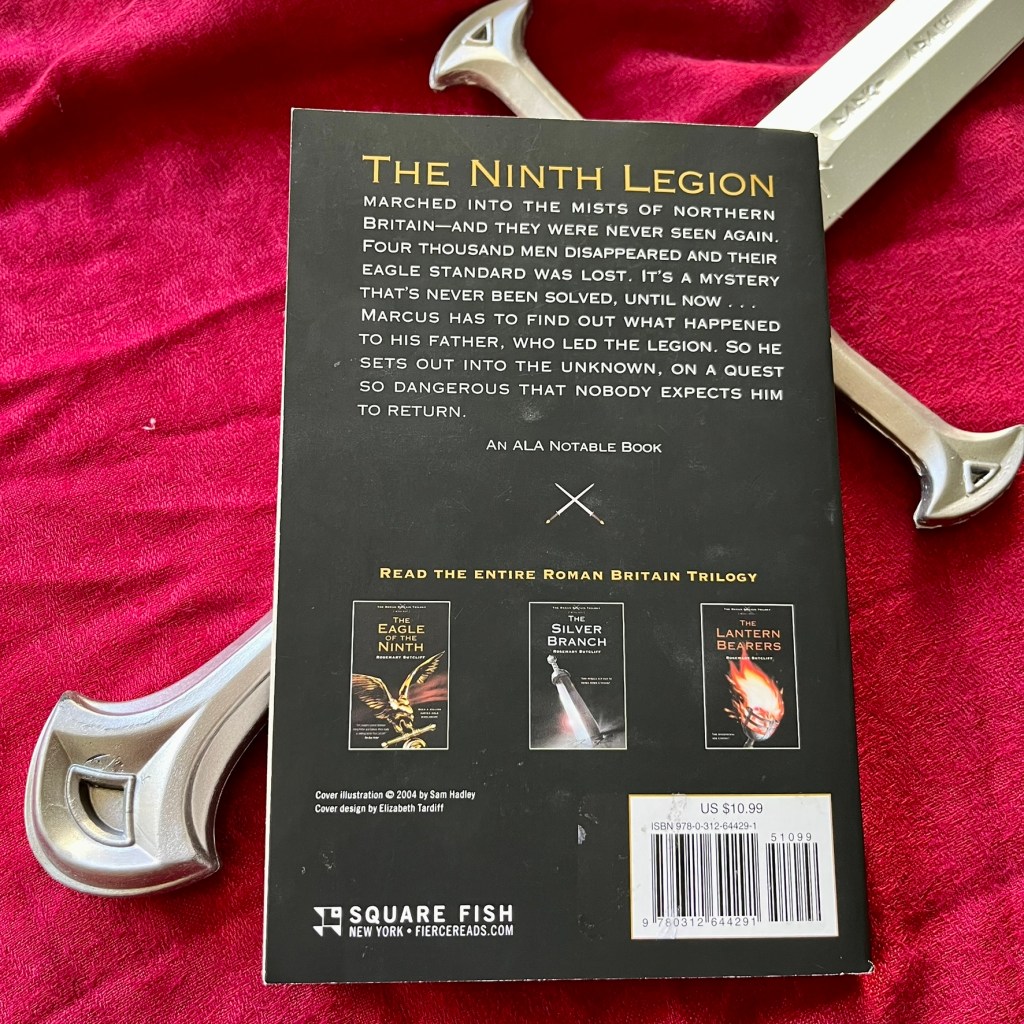
Fourteen years ago, the Ninth Legion of the Roman army disappeared into the mists beyond Hadrian’s Wall—and never returned. Now rumors are swirling south into Roman territory that the Eagle, the Legion’s idolized symbol, has been sighted.
Centurion Marcus Aquila has been languishing at his uncle’s estate, recovering from the injury that discharged him from duty. But when he hears of his father’s lost legion, he knows he must retrieve the eagle and, if possible, reassemble the Ninth at all costs. Otherwise, the Britons will have a powerful god-like weapon to wield against occupying Rome.
Marcus and his Briton slave-become-friend, Esca, set out to follow the faded footsteps of the Ninth Legion and bring glory to Rome by recovering the lost eagle and solving the mystery of the Ninth’s disappearance.
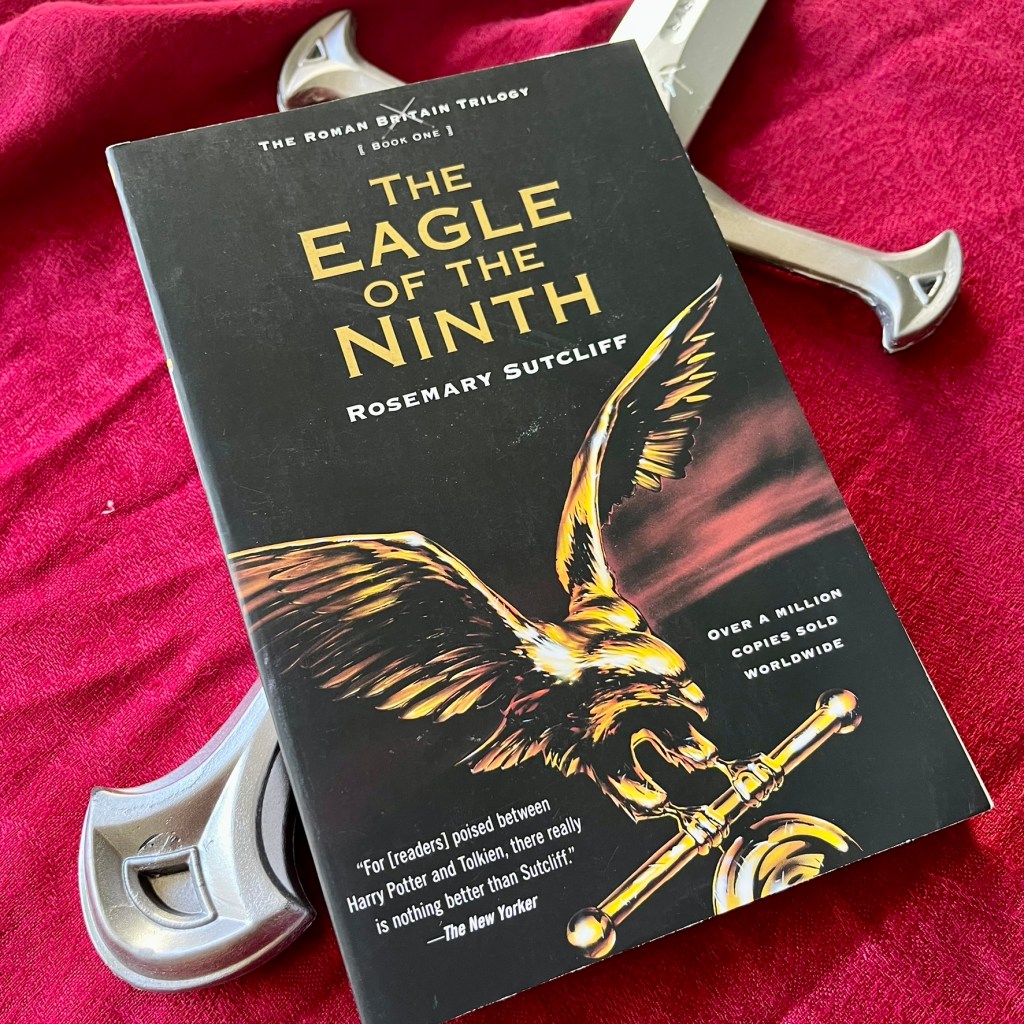
Rosemary Sutcliff’s YA historical novel The Eagle of the Ninth has been one of my all-time favorite books for years. And it still is.
After re-reading this story first published in 1954, I have to tell you why I love it.
1. The Wholesome Content
Some books are like a knock-off travel bag featured by influencers on TikTok: full of glitter and cheap stitching that falls apart after the first use. Other books might be a roller suitcase from the retail store, a little more durable but made in bulk at a distant factory, nothing special.
Still other books can be equated to the old wooden trunk in the corner of the antique shop: used by generations and still with life to spare.
Like that trunk, The Eagle of the Ninth feels rock-solid. The male leads, their friendship, their adventures, their motives—they all carry an old-fashioned sense of wholesomeness.
No gratuitous violence. No sex (not even a kiss). No language. No agenda-driven representation.
What sells this story is the story, said and done. (Imagine that.) I was sold on the first read, and I’ve been sold every read since.
(If you didn’t know, it’s the first in a series of three. I’ve read the second, The Silver Branch, but not the last one, The Lantern Bearers, yet. So far I like The Eagle of the Ninth best.)
2. The Cinematic Writing
Storytelling is storytelling, and while books and movies are different media, you know it’s a good book when it reads like a movie: the chapter breaks, the scenery descriptions, the full-circle moments (motifs) with objects and settings, the POV changes, the pan-aways to other characters and zoom-ins to specific details.
If you can visualize in your head the way you watch on a screen, that’s good storytelling, and Rosemary Sutcliff does it.
3. The Cool Adventure
If you’re looking for a book that has “cool factor,” this is it:
- fight scenes
- chases on horseback and on foot
- weapons (Roman and British)
- military, warrior, and hunter lifestyles
- awesome vistas of nature and structure alike (the written version of vista, anyway—see my point on cinematic writing)
- plenty of suspense throughout
- and a wolf cub for a pet
The Eagle of the Ninth reads like it was written for boys, in a good way, and I hope more male readers—of any age—find it and appreciate it.
This story is not non-stop adrenaline, however; be prepared for a bit of a slower pace through the first third or so. While this portion of the story certainly contains its own tension and foreshadowing, it primarily sets the stage for the rest of the story.
4. The Historical Details
True to the genre of historical fiction, Rosemary Sutcliff brings history to life with her descriptions, cultural details, and terms of Ancient Rome and Ancient Britain alike. Whether at the fortress along the Wall, in the village of Calleva, or north in the wild downs of the tribes, I felt like I had been teleported there and was experiencing the story along with the characters.
Points for new vocabulary like tessellated, cresset, spandril, and gralloch.
5. The Positive Themes
Part of what draws me to this story, and makes it linger in my mind, are its heartbeats of friendship, loyalty, honor, and sacrifice. Like The Lord of the Rings, like Gladiator, like The Chronicles of Prydain and my other favorite stories, The Eagle of the Ninth portrays characters and characteristics worth emulating.
As a character himself, I found Marcus quite relatable (even though I’m not a guy). His ambition, his sacrifice, his wars, and his friendships make him as human as my next-door neighbor and had me invested in his story from start to finish.
I also appreciated the blend of personal and national stakes: Marcus not only wants to find out what happened to his father but also wants to preserve the Legion’s legacy and ultimately protect Rome’s political and military power in Britain. I believe it’s this dual motivation that makes Marcus a reflection of both the humans we are and the humans we aspire to be.
P.S. Unexpected friendship is one of my favorite tropes, and the unlikely brotherhood between Marcus and Esca is probably what nestles this book so securely in my heart.
6. The Personal Emotions
If you’re surprised to see me talk about emotions in a book as male-forward as The Eagle of the Ninth, it’s because I was surprised to be so impacted by Marcus’s injury, recovery, and limitations afterward. Perhaps I could relate so closely because of my history with chronic illness.
It was the thing that Marcus had been afraid of ever since his interview with Centurion Maximus. No need to be afraid now, not anymore. He took it very quietly; but it meant the loss of almost everything he cared about. Life with the Eagles was the only kind of life he had ever thought of, the only kind that he had any training for; and now it was over. . . . The Legion was lost to him and, with the Legion, it seemed that his own land was lost to him too; and the future, with a lame leg and no money and no prospects, seemed at first sight rather bleak and terrifying.
Chapter IV, “The Last Rose Falls”
The autumn was a bad time for Marcus, feeling wretchedly ill for the first time in his life, almost always in pain, and face to face with the wreckage of everything he knew and cared about.
Chapter V, “Saturnalia Games”
Been there, done that. Though Marcus doesn’t spend the rest of the book an invalid—he carries on quite well despite a leg that never returns to 100% capacity—his physical and emotional struggles are most relatable to any reader who has experienced a significant injury or illness.
There you have it: The Eagle of the Ninth by Rosemary Sutcliff, a historical novel equally rousing and heartwarming, action-packed and emotion-driven, relatable and admirable. Grab your sword or your spear, take up the reins of your pony, and head into the mists of northern Britain with Marcus and Esca after the lost Eagle of the Roman Legion.
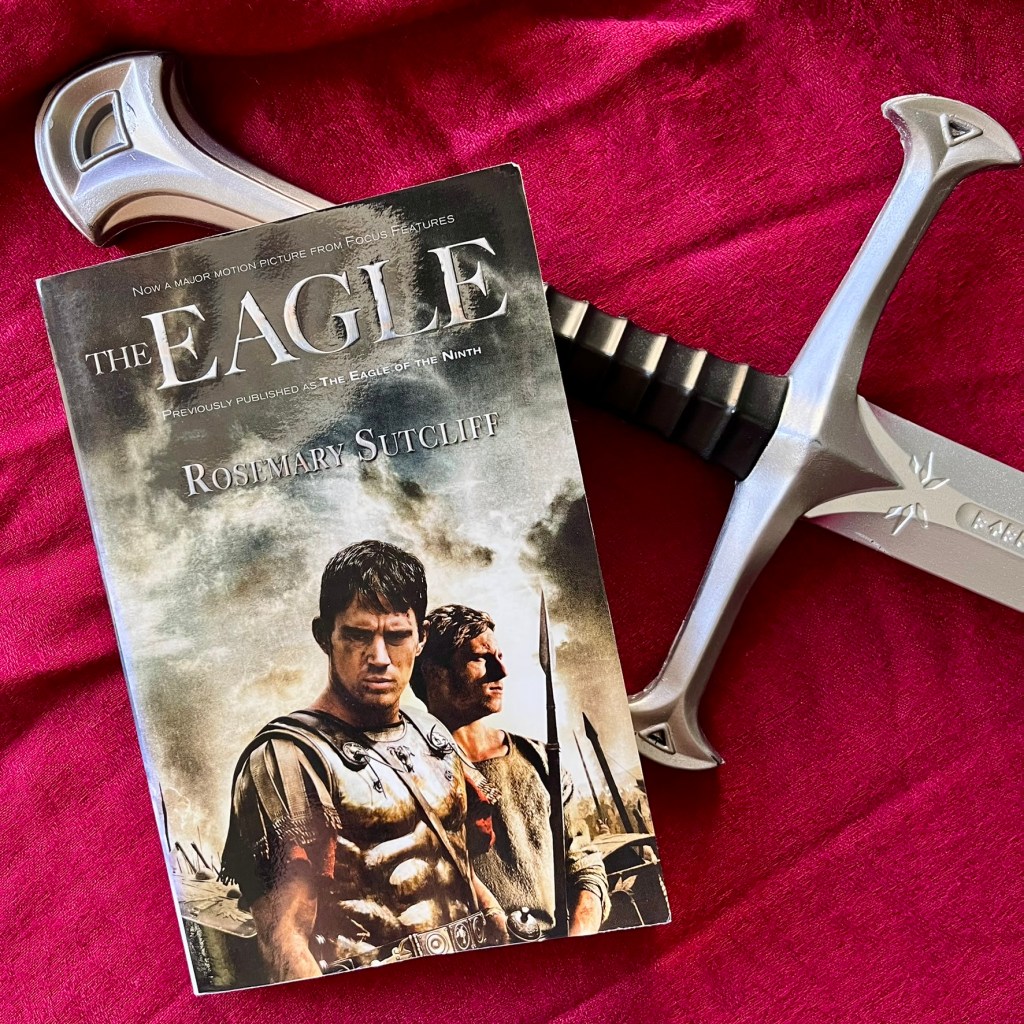
Disclaimer: Any photos of the book cover featuring the 2011 movie do not serve as an endorsement of the movie. The book is better.

